
Skip to content

Bringing ibestt to Preschool

Haring Center Mobile Application to Expand to Early Education

Haring Center researchers are expanding ibestt (Integrating Behavior Support and Team Technology), a product developed and tested through a Center research grant, to be used in preschool and other early childhood programs.

After successfully rolling out an initial version for elementary schools that is being used in school districts across both Washington and Oregon, the ibestt research team won another grant from the Department of Education to further develop the program for early learning programs.

“This is exciting news for us,” said principal investigator Scott Spaulding, Ph.D. “When we first started working on ibestt, we said ‘wouldn’t it be great to bring this to preschools too?’”

ibestt is a web-based application for mobile devices that helps teaching teams address problem behaviors exhibited by students. It provides online coaching and collaboration for teachers to implement team-based supports for student behaviors. The early learning ibestt project’s principal investigators are Spaulding and Kathleen Meeker, Ph.D.
Spaulding noted that the preschool version of ibestt will be different than the elementary school version. While the early learning version will provide all the features of the elementary school version, the research team plans to explore how those features will work for teams who teach children of different ages.

“It is important for us to get the input of all the people who will be using it every day to prepare and facilitate their behavior plans,” Spaulding said.

During the first year of the four-year grant, researchers have invited teachers and behavior specialists to discuss how successful behavioral teams have worked for preschool-aged children, as well as what they would like to see in the application. The researchers also plan to meet with families this spring to get their point of view as well.
Spaulding said that the ibestt team will be using this opportunity to upgrade some features of the original version as well.

“Creating a tool where families can more easily and effectively contribute to a child’s plan is something that would greatly benefit the current ibestt program,” he said. “We plan on adding this and possibly a few other functions to the already existing ibestt program that will make that experience better for families and childcare teams.”
Another upgrade will be to add an integrated coaching component, which will better provide educators with the first steps needed to best implement ibestt into their intervention teams.

During the second year of the grant, our researchers will create a prototype to be used in local schools. The first ibestt prototype was used in Highline School District four years ago, where researchers worked with teams to get feedback and calibrate their application. Training materials for the ibestt technology will be developed in the third year of the grant and then it will be tested with a larger group of schools in the fourth year.

For more information about ibestt, visit the project website (ibestt.org), or contact Scott Spaulding or Kathleen Meeker.
Recognized for Excellence

In 2018 Haring Center Researchers were Celebrated for Their Work and Supported for Future Endeavors

Last year was a year of recognition for the UW Haring Center.

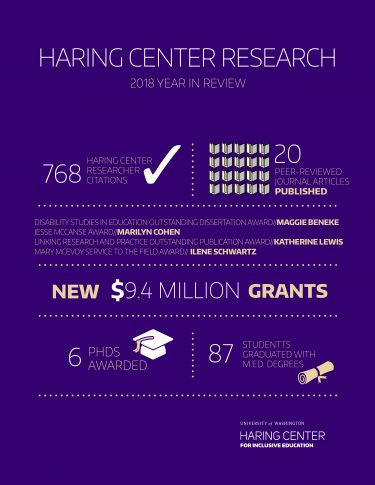
Not only were Haring Center research faculty awarded nearly $9.4 million in grant money to fund 11 research projects for the upcoming year, but they were also recognized for excellence in their previous work.

“I think what these awards show is that we have been, and are currently, doing important work in the field,” said Haring Center Research Director Kathleen Artman Meeker. “And the new grants show that there is a lot of faith in our researchers to continue to search for important answers to meaningful questions.”

These research grants were awarded after competitive submission processes to premier federal agencies such as the National Science Foundation, the National Institutes of Health and the U.S. Department of Education.

Meeker said many of the grants focused on a similar theme: training and supporting teachers so they can provide the best practices to develop the social and emotional learning of all young children.

“We know what works to help the children, but how to do that in a way that is sustainable, equitable and available to all students is the next challenge,” she said.

Two Haring Center researchers were honored for their sustained contributions to their field. Ilene Schwartz, Ph.D., was awarded the Mary McEvoy Service to the Field Award by the Council for Exceptional Children Division for Early Childhood. The National Telemedia Council awarded the Jessie McCanse Award to Marilyn Cohen, Ph.D., for her longtime dedication to media literacy.

Two more Haring Center researchers were recognized for work published in 2018. Maggie Beneke, Ph.D., won the American Educational Research Association’s Disability Studies in Education Outstanding Dissertation Award for her dissertation “Race and Ability Talk in Early Childhood: Critical Inquiry into Shared Book Reading Practices with Pre-service Teachers.” Katherine Lewis, Ph.D., was awarded the Linking Research and Practice Outstanding Publication Award by the National Council of Teachers of Mathematics Research Committee for her co-authored study “Productive Struggle for All: Differentiated Instruction.”

Part of the Haring Center mission is to provide University of Washington students the education and experience needed to become leaders in the field of inclusive education for years to come. In 2018 Ph.D.s were awarded to six graduate students who were mentored by Haring Center faculty, and 87 students graduated with a masters of education in special education. This includes 50 students in Applied Behavior Analysis, 16 students in Early Childhood Special Education, 12 students in Severe Disabilities, and nine students in High Incidence Disabilities. These Haring Center-trained graduates will take the knowledge and experience gained here, and put them into practice in their own professional work, spreading the important work of the Haring Center to schools and sites all over the country.

“We are really optimistic,” Artman Meeker said. “The number of projects and student accomplishments grew significantly in 2018. We’ve created and cultivated productive partnerships and we are very excited to see what happens next.”

We Believe

The Haring Center for Inclusive Education has tackled early learning’s most challenging questions for more than 50 years. Today, we stay true to this legacy by untangling the toughest obstacles to serving children with disabilities and their families. Our unwavering commitment to advancing inclusive education creates a better future for all children.

Leading the Field: Haring Center Faculty Respond to Change in Applied Behavior Analysis Practice

How a Simple Change in the BCBA Code of Ethics Could Completely Change the Field

Dr. Nancy Rosenberg (left), Dr. Ilene Schwartz (right)

Two Haring Center Board Certified Behavior Analysts (BCBA) have taken issue with the newest version of the Professional and Ethical Compliance Code for Behavior Analysts. Center faculty Dr. Ilene Schwartz and Dr. Nancy Rosenberg have published a new paper in the journal Behavior Analysis in Practice to voice their response to the changes.

BCBAs are professionals who have specialized expertise in the field of Applied Behavior Analysis (ABA), a widely-used teaching approach for individuals with disabilities. BCBAs oversee educational and behavioral intervention programs for young children in school, home, and clinical settings. The UW College of Education has a certification program in ABA, which Dr. Schwartz and Dr. Rosenberg oversee.

In 2016, the Behavior Analyst Certification Board (BACB) revised the ethical code it published in 2001. This document dictates how BCBAs should act professionally. The most stunning change to the code was not anything added or subtracted — it was a change in the nature of the code. Prior to 2016, the ethical code was a guideline to help BCBAs navigate various dilemmas. The certification board changed this dynamic of the code from guidelines to a set of enforceable rules which could result in a BCBA losing their license.

“This is a big difference in how our field is approaching our work. There is now fear around the code,” said Rosenberg. “We have to figure out how to obey it and not get in trouble instead of finding the most ethical course of action.”

Since the rules have become black and white, as well as enforceable, BCBAs can now be brought before the board and decertified for not adhering to them. Rosenberg, who teaches BCBA ethics at the University of Washington, says that this change is not practical.

“In my classes we work through specific instances where after debating and considering all the complexities, you should do something different than what the code suggests,” she said.

An example of such behavior is BCBAs are no longer permitted to accept gifts of any kind. This has been a guideline for decades, but now it is a punishable edict. While good intentioned, this rule is not practical for all situations, and can be culturally insensitive. A cup of coffee is considered a gift, and also hospitality in some cultures and could offend a BCBA’s client by not accepting, thereby dissolving trust between the two.

Rosenberg went as far to say there are conflicts in the code where certain case studies make it impossible to comply completely with the code.

That the code went from being guidelines to hard-and-fast rules isn’t the whole issue, it is that there was not any discussion about this change within the field. Had that occurred, there might be fewer potential negative implications and consequences as a result.

What Rosenberg and Schwartz propose a solution: an ethical decision-making process to guide BCBAs through specific ethical dilemmas.

“It’s not about a set of rules that encourages non-thoughtfulness,” Rosenberg said. “It’s about seeking out the highest levels of ethical behavior in all situations while considering all the unique variables.”

For more information on the new paper or BCBA ethics, contact Nancy Rosenberg at nancyr@uw.edu.

Impact Doesn’t Stop Here

Haring Center 2018 Training Impact by the Numbers

At the Haring Center, we know what it means to champion inclusion each and every day. We believe that every child should have meaningful opportunities to learn, to engage with others, and to live in an inclusive community that values all its members. For over 50 years, we’ve pursued this goal through our innovative model of research, education, and training.

An integral part of the Haring Center mission is disseminating the practices that are developed, researched, and demonstrated in the classrooms of the Center’s school, the Experimental Education Unit (EEU), through high quality professional development and training. Once the leading-edge practices our researchers develop are proven to be effective, we train educators across the state of Washington, the US, and the world to implement them so countless more students, schools, and communities beyond the walls of the Haring Center can benefit.

Our team of expert trainers work with educators, leaders, and other professionals to help a variety of organizations implement inclusive education. We create individualized professional development plans to meet the unique needs of our partner programs. The training strategies used in our professional development work are designed to impact maximum change and optimize the use of target teaching strategies in classrooms, which doesn’t always happen with traditional training methods.

“We know that with traditional training strategies, only about 5% of teachers are going to be able to take what they’ve learned and use it in their classrooms on their own”, said Haring Center professional development partner manager Brittney Lee. “The professional development techniques used by Haring Center trainers are based on the science of adult learning and the most current research in teacher training. The goal of using a wide range of training strategies is to ensure that teachers are able to use the inclusive practices as successfully as possible in their classrooms.”

During the 2017-18 school year, our professional development impact was far-reaching. Our team of 18 training specialists worked with 146 different schools and organizations, training 3,100 educational professionals throughout the year. Haring Center staff conducted trainings close to home, in cities across Washington State, and beyond, including in Grand Cayman, Nigeria, and Singapore. In addition to school districts across the state, our partners include the Bill & Melinda Gates Foundation, Child Care Aware of Washington, Washington Department of Child, Youth, and Family Services, Seattle Preschool Program, Seattle Opera, and the Woodland Park Zoo.

For more information on Haring Center professional development and training, contact Alison Winfield at avw@uw.edu.