Skip to content

Research to Practice: The Importance of Physical Activity for Students with Autism and Other Developmental Disabilities

Previewing the Haring Center’s 2018-19 DUBs Talk Series
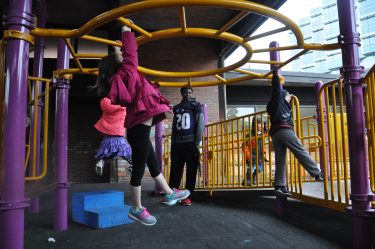
Everyone knows exercise is important to a healthy lifestyle.

However, Haring Center research has identified that the benefits of exercise can extend beyond staying physically healthy for young children with disabilities. These exciting findings will be highlighted in the Haring Center’s 2018-19 DUBs Talks series on the importance of physical activity and play for young children with autism and other developmental disabilities.

DUBs Talks are a series of public talks put on by the Haring Center to ‘Develop, Understand and Build’ (DUB) on research into the current best practices in inclusive education. Much of the research described during DUBs Talks takes place at the Haring Center in the classrooms of the Center’s school, the Experimental Education Unit (EEU).

This year’s DUBs Talks topic is critical for teachers and families of young children with special needs. Children with disabilities often engage in lower rates of physical activity than their typically developing peers. This lack of activity not only has detrimental health effects, but academic, behavioral and social implications as well.

Haring Center researcher Dr. Shane Miramontez’s research focuses on the effects of physical activity on the development of children with disabilities and on practical strategies that teachers can use to optimize time spent in physical play. In a recent study, Miramontez found that how teachers plan and structure their outdoor activities can directly affect how much time children with special needs spend socializing with their peers and increase participation during interactions.

At the fall DUBs Talk on Wednesday, November 7, Dr. Miramontez will share the results of her research in which children with disabilities participated in specific activities both in the classroom and on the playground and how those activities affected their overall level of physical activity and on-task behavior. She will also share examples of activities that can better engage all children during recess.

“I hope people come away learning just how important physical activity can be for all children, but especially children with disabilities,” Miramontez said. “And I hope they learn some new ways to better incorporate physical activities throughout a school day such that all children can physically engaging their world while at school.”

This will be the first of the Haring Center’s two 2018-19 DUBs Talks year exploring strategies to support the physical development of children with disabilities. In the spring 2019 DUBs Talk, Haring Center Researcher Dr. Jen Fung will team up with EEU physical therapists Renee France and Julia Odland to talk about the results of their study of the Special Olympics Young Athletes Curriculum. That study is happening right now at the EEU.

DUBs Talks are free and open to the public. If you wish to attend either DUBs Talk, email pdutrain@uw.edu. If you cannot attend but wish to view, the talk will be live streamed on the Haring Center’s Facebook profile.

School’s in Session

Looking Ahead to a Great Year of Research in the Haring Center’s Classrooms

School is back in session at the UW Haring Center’s lab school, Experimental Education Unit (EEU), for kids, teachers, and University of Washington researchers.
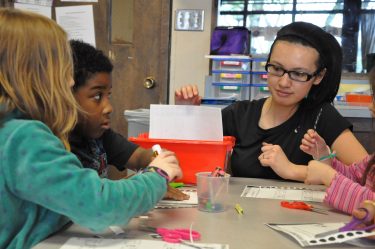
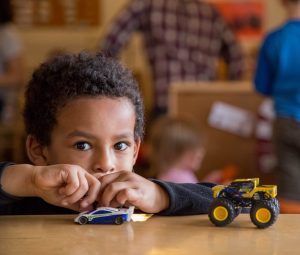
EEU staff continuously partner with UW College of Education student and faculty researchers to develop and test cutting edge strategies to improve the quality of inclusive early learning and early intervention for all children. This year, one such partnership will be between EEU preschool and kindergarten teachers  and  Haring Center researcher Dr. Maggie Beneke to examine conversations with young children about ability and race through shared book reading.

This is study is an extension of Beneke’s dissertation, titled “Race and Ability Talk in Early Childhood: Critical Inquiry into Shared Book Reading Practices with Pre-service Teachers,” which won the American Educational Research Association’s 2018 Disability Studies in Education Outstanding Dissertation Award.

Conversations about ability and race in early childhood can have a significant impact on their views about themselves and those in their communities. In the EEU study, teachers will select which books they read to ensure book topics are relevant and interesting to the specific children in their classrooms. Teachers will then be videotaped while engaging in shared reading during regularly scheduled literacy times in the classroom. Participating teachers will have the opportunity to review the videos with Dr. Beneke. Together, Beneke and the teachers will analyze the video with the goal of increasing opportunities for children to participate in conversations about ability and race.

“The teachers are excited,” said Beneke. “This work is hard. We talked about how aspects of this work will be uncomfortable, but the teachers have shared how they’ve wanted to engage in anti-bias practices. This study will be a supported opportunity for the teachers to explore anti-bias practices in their own classroom settings.”

Beneke’s study at the EEU extends her dissertation in several ways. For example, while Beneke’s dissertation focused on teacher candidates, at the EEU Beneke will work with experienced teachers. Additionally, Beneke has designed the EEU study to examine the role of professional learning communities in supporting teachers’ practice – participating head teachers will engage in five study groups to discuss their practice, analyze classroom discourse, and provide each other with feedback.

“This study has shared goals and commitments with the EEU’s Equity Change Team to build anti-bias learning communities, as well as to build stronger anti-bias skills for staff,” said Beneke.

UW College of Education professors conduct dozens of studies at the EEU annually. In addition, the EEU’s classrooms are where student research by undergraduate, graduate and doctoral candidates occurs throughout the year. EEU teachers have a rich history or participating in all studies that impact future generations of students, as well as those currently in their classroom. In 2017-18, teachers worked to develop a comprehensive screening for a Multi-Tiered System of Supports (MTSS) for children in preschool and kindergarten. Read more about that study here.

The EEU is the heart of the Haring Center, which act as ‘living laboratories’ for researchers who seek to innovate and discover new best practices for children of all abilities and backgrounds. Once verified, those practices are then taught and coached by Haring Center staff to professional educators throughout Washington state and beyond.

Equity and Inclusion Start Here

UW Haring Center Researchers Aim to Advance Racial Equality in Teacher Preparation

Two Haring Center researchers were awarded a two-year grant by the Professional Educator Standards Board to better prepare the teachers of tomorrow by providing a foundation in inclusive education and racial equity at the University of Washington.

“Our hope is to show our teaching candidates that inclusion is an ongoing, dynamic process that requires critical reflection,” said Maggie Beneke, Ph.D. “As well as to address the disproportional representation of children and youth of color across the state and country in special education classrooms.”

Beneke and Selma Powell, Ph.D., have begun work on the grant by revising curriculum in the special education teacher preparation program in the UW College of Education. The first step was to draft an inclusion and racial equity statement. Then all special education faculty reviewed their class syllabi to include sections in each course dedicated to a continued conversation about equity and diversity.

“Diversity classes are often standalone experiences,” said Powell. “Those types of experiences have not been as effective as when issues of equity are continuously integrated in every class.”

The future special education teacher preparation curriculum will focus on advancing racial equity inclusion. Specifically, courses will address how unexamined bias in systems can fail students, but also push teacher candidates to explore their own identities and biases, and to process how these contribute to who they are now and who they want to be as teachers.

Drs. Beneke and Powell have also connected with members of the Seattle community, inviting families of color who have children with disabilities to share their frustrations and successes in special education.

“It will be very powerful to hear local families of color as they share their experiences in special education and tell us the skills they think would help better our teachers and schools,” said Beneke.

This grant also bolsters an already existing partnership between Seattle Public Schools (SPS) and the University of Washington to target the recruitment and retention of teacher candidates of color. Powell will provide face-to-face information sessions to SPS instructional assistants with attention given to the location and timing of sessions to provide equitable opportunities for perspective students (nights, weekends, etc).

The $20,000 grant has allowed Beneke and Powell to pursue greater equity and inclusion at the UW College of Education, something they have been hoping to do since before receiving the grant.

“This grant has provided us the time we need to get started,” said Beneke. “We intend to keep doing this work after the grant’s two years are up.”

For more information about this project, you can contact Beneke at beneke@uw.edu or Selma Powell at selmap@uw.edu.

Working Toward Widespread Inclusion

A Profile of How Haring Center Trainers Have Helped Wing Luke Elementary

Three years ago, Seattle Public Schools contracted the Haring Center to provide coaching and technical assistance to increase the use of inclusive practices across the district.

As part of this contract, Haring Center Inclusion Trainer, Zoe Leverson, has been working closely with four schools throughout SPS (Leschi Elementary, Thornton Creek Elementary, Wing Luke Elementary and Louisa Boren STEM K-8) to assess their inclusion needs and provide a professional development plan that focuses on providing evidence-based education to all children, regardless of ability. One of the main goals is to help children with special needs thrive in general education classrooms.

“Zoe has been amazing,” said longtime Wing Luke teacher Erika Edwards. “She is always thinking about ways to best serve all kids and showing kids that we all have differences and we should embrace them. As a result of our work with Zoe, the progress we’ve seen in many students has been great.”

Zoe said her first year at each school looked similar, determining strengths and needs of the administration, staff and students.  The work in the following years was highly individualized for each school, based on the goals and priorities set for each at the end of the initial year.

As an example, in her second year with the Wing Luke Elementary, Zoe created a professional growth plan that supported both the administration and the teaching staff. As part of her work with the teachers, she teamed up with staff to speak to the children about inclusion. For children in kindergarten through second grade, that conversation focused similarities and differences. In grades three through five, the focus was about equality vs. equity.

The type of multi-level support was consistent with the plans she creates with each school she works with. The most common areas of need in each school are:

  1. Facilitating a better working relationship between general education and special education teachers.

This can be just as much an administrative and infrastructure deficiency as a lack of communication between staff members.

“This level of cooperation isn’t always taught or valued in every school,” Zoe said. “But it is essential for every educator/therapist/administrator who is responsible for a child’s education to speak regularly to discover better ways to support him or her.”

At Wing Luke, Erika recalls needing this level of support among the staff when working with a non-verbal student in her classroom. As a result of the collaboration facilitated by Zoe, the team was able to find a way for the student to communicate using an iPad, which helped her participate and contribute in the general education classroom. Continued collaboration resulted in strategies that further enhanced the student’s use of the iPad.

  1. Training and continued support for instructional assistants in the general education environment.

Most schools do not have designated resources to provide specialized training to instructional assistants (IAs), including planned and compensated time for ongoing IA training.

“IA’s are a critical part of a classroom team. When the special education team has many kids on their caseload throughout many general education classrooms, you cannot be there for every student all the time. You have to rely on your IAs to continue the plans for your classroom and individual students. Training and ongoing support is essential for IA’s to be able to be successful,” Zoe said.

  1. Developing an agreed upon perception of inclusion.

“Everyone brings their own experience and expertise into what inclusion means to them,” Zoe states. “The first thing we need to decide is what that looks like for each classroom and each child, and then we can work from there.”

To increase their impact into our community, the Haring Center will continue to partner with SPS and will add a fifth school to its portfolio in the upcoming school year. While areas of focus and need for support have varied from school to school, each one has made significant steps both inside and outside of the classroom toward a more inclusive education experience for children.

If you’d like more information on the Haring Center’s inclusion coaches and consultants, contact Alison Winfield at avw@uw.edu.