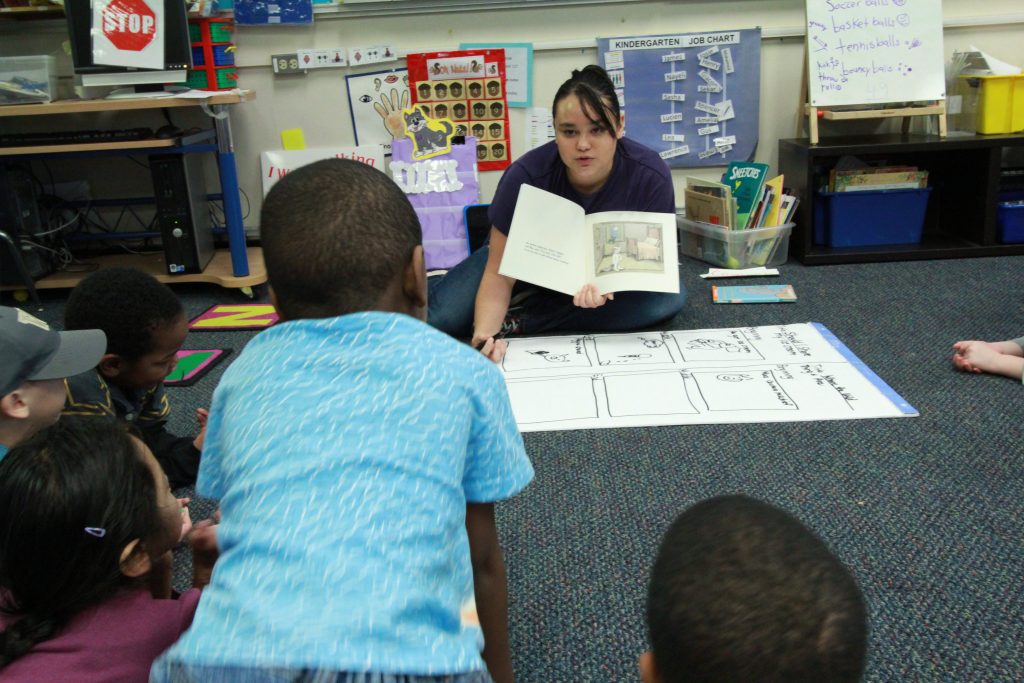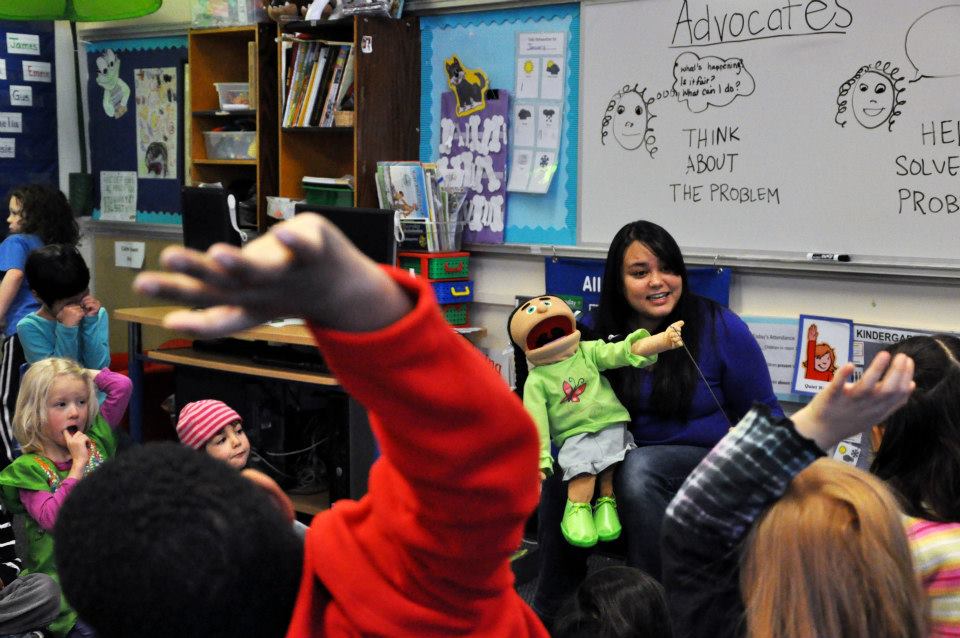
Jordan Taitingfong is Director of Equity at the EEU at the Haring Center and an educator whose work explores disability identity, interdependence, and belonging in early childhood. A former teacher of young children and now an educator of adults, she examines how schools shape children’s understandings of race, disability, and power from the earliest years. Grounded in Disability Justice and Oceanic perspectives, her work positions disability as culture, history, and collective inheritance.
Q: Can you describe your current role at the EEU and what your day-to-day work with teachers and staff looks like?
A: I am currently the Equity Director at the EEU, and my work focuses on our values around equity, inclusion, and community belonging and how those show up in everything we do.
I work with staff, especially teachers, on how those values are reflected in classroom practice. That includes professional development, reflecting on how our identities shape teaching, and thinking about how we support children in understanding their own identities.
Sometimes that looks like formal professional development, and sometimes it’s working with teams to navigate complex moments with children or families. Much of my role is helping teachers reflect on what’s happening in their classrooms and across the school so we can better support kids and families.
I’ve been at the EEU for more than twenty years. I started here as an undergraduate and have held many roles. I taught for ten years, and before that I was an instructional assistant and a graduate student. I also worked as a coach in the Professional Development Unit.
Those experiences, from working directly with kids and families to supporting teachers, now inform how I help guide the school’s work around equity and belonging.
Q: What first drew you to equity and inclusion work in early childhood spaces?
A: My own experience as a child definitely had an impact on my understanding of race and racism in schools.
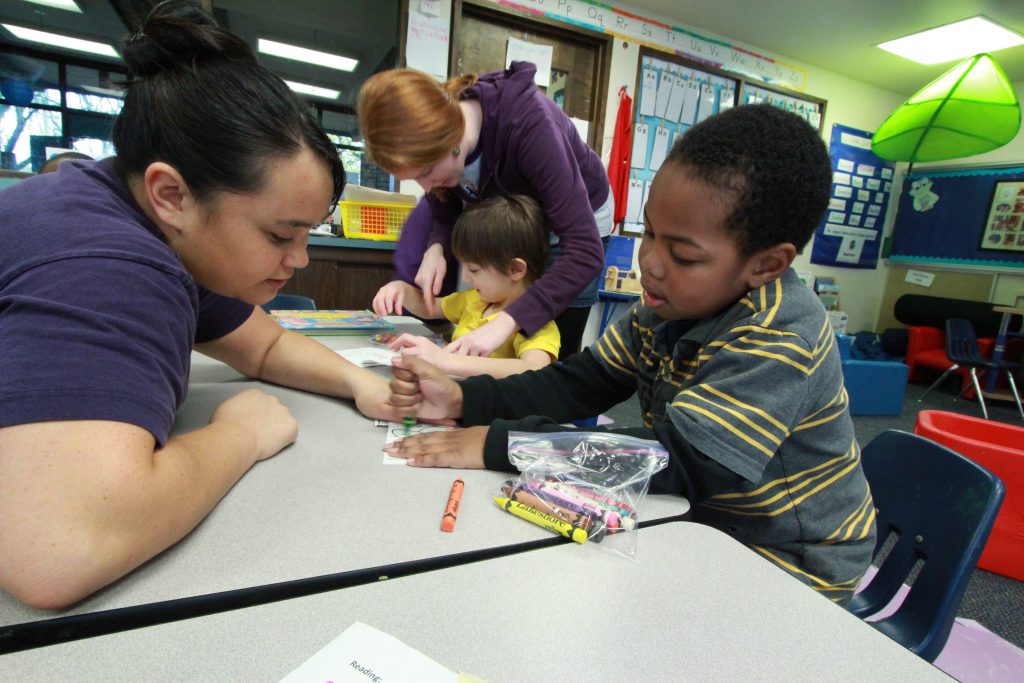
I grew up going to a Department of Defense school for elementary school, which was really diverse. Then in middle school we moved to northern Washington, where I was the only kid of color in my school. I had a lot of experiences with racism from the kids, the community, and also from my teachers.
Later I became a teacher myself. As I continued to work in classrooms and think about those experiences, I started thinking more about how important it is to talk with kids about race in positive ways, especially for kids of color, so they can build a strong and protective sense of identity.
I also started seeing similar patterns around disability while working in inclusive classrooms. I was especially thinking about kids who live at that intersection, children who both have a disability and are kids of color. I saw how differently they were experiencing the system, and how families were trying to support their children while navigating that.
For example, the same diagnosis for a white child and a Black child could lead to very different outcomes in terms of resources or recommendations. Seeing that made me want to learn more about what was happening at the systems level so I could try to make changes for kids and families.
I grew up on a Navy base in Rota, Spain. My dad was in the civil service, so I attended Department of Defense schools there through elementary school. Looking back now as an adult, I can see more clearly how disability and race were tied together in my own experience.
In that very racially diverse environment, I was considered a gifted student and was placed in gifted classes. But when we moved to northern Washington, there was suddenly a lot of conversation about me being behind or about my behavior. That shift happened at the same time I was experiencing a lot of racism. I didn’t understand it at the time, but now I can see how connected those experiences were.
Q: Can you share a moment, story, or example that captures why this work matters to you?
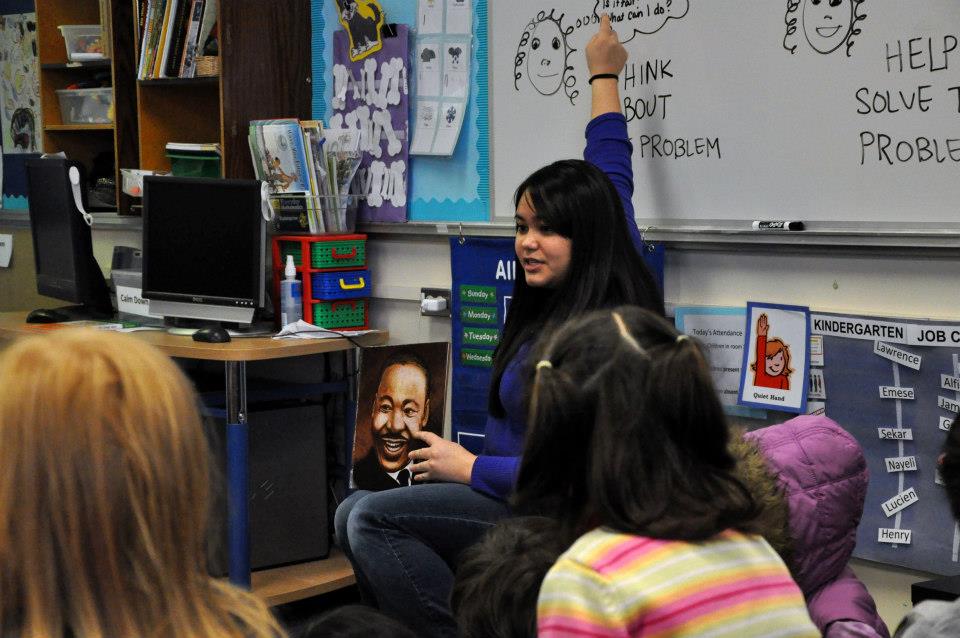
A: A story that I share a lot really shows how important it is for adults to set, teach, and practice the values we want to see in a classroom. When we do that well, kids take those ideas and run with them in ways we couldn’t come up with ourselves.
When I was teaching kindergarten, I had a set of twins in my class. One of them had a disability and was non-speaking and was just starting to learn how to use AAC (Augmentative and Alternative Communication). She loved to stim. She loved watching water, dropping toys, and listening to things fall.
We were really struggling with the idea that she needed to play like the other kids. During free choice time, we kept trying to figure out how to include her in the same kinds of play as everyone else, even though that wasn’t what she wanted to do with her time.
Throughout the year we worked really hard talking with the class about how everyone belonged in our classroom. Everyone was meant to be there. Everyone should be playing together. Leaving kids out was not okay, and being welcoming and kind was really important.
One day a little boy came up to me and said she was taking all the marbles from their game and dropping them. He wanted me to solve the problem. I said, “It sounds like she really loves playing with them.” He looked at me and walked away.
About ten minutes later we looked over and the kids had built a marble maze. They had set it up, on their own, and her job was to drop the marbles into the maze.
In that moment they created something so much better than what we had been trying to do as adults. She was legitimately enjoying herself and playing. It wasn’t something we were trying to force.
They figured it out. Our job was to teach them that everyone can play together and that it’s their job to get creative about it.
“Our job was to teach them that everyone can play together and that it’s their job to get creative about it.”
That’s a story I share a lot because I want teachers to think about how they model those values for kids. We want children to leave school with the skills to build belonging wherever they go.
Q: You shared that your talk will explore what it means for children to arrive in early childhood spaces already whole. Can you say more about what you mean by that?
Especially in early childhood, there’s this assumption that adults are shaping kids so they’re ready for school. We talk a lot about being school ready or kindergarten ready.
But when I was a kindergarten teacher, I always felt like if you’re in kindergarten, you’re kindergarten ready. You don’t have to be performing in a certain way or be at a certain level to belong there.
“If you’re in kindergarten, you’re kindergarten ready.“
This becomes really important when we’re thinking about disability. We do kids a disservice when we start from the idea that they’re not ready, or that something about them needs to be fixed or remediated.
When I think about wholeness it’s connected to ideas of readiness, I want to push back on that framing because all kids come with identities they just haven’t explored yet, and those identities often get overshadowed by how we evaluate their performance.
We also don’t do a great job, especially for kids with disabilities, of teaching them about their identity. We don’t teach them about disability history or the many people who have existed across time with disabilities who mattered like they do.
If we think about kids as showing up with those histories and with the right to participate simply because they are there, then we’re thinking about them in more whole ways. I don’t want kids to feel like they have to leave a part of themselves behind to be in a classroom and I don’t want teachers thinking that they’re only job is to get kids ready or work on the ways they aren’t ready, I want them to see they’re already whole when they come into a classroom.
Q: How do Oceanic perspectives and disability justice frameworks shape your approach to this topic?
A: I think a lot about Oceanic perspectives and disability justice perspectives together, especially around the importance of interdependence.
Disability justice really emphasizes the value of all bodies and all minds and the idea that we depend on each other. Oceanic perspectives also focus on relationality and collective responsibility.
When I think about those things together, it opens up different ways of thinking about what children need and what classroom communities can look like.
For example, when I was a teacher we were always told that if we wrote an IEP goal, it needed to be written toward independence. The end goal was that the child could do something independently.
But that’s not necessarily the best goal for all kids or all ways of being.
If we think more about interdependence, we can expand how we organize classrooms and how kids learn from each other. A classroom is already a community. There are enough people there to support participation.
That perspective allows us to think differently about what learning and belonging can look like.
Q: What do you hope educators, students, and community members walk away thinking or doing differently after attending your talk?
I think for people who have never thought about disability as an identity, I hope they begin to explore that idea. Disability has a culture and a really powerful community. Disabled kids have the right to be part of that.
For teachers, I hope they walk away thinking creatively about their classrooms and recognizing that it’s all of our responsibility to build spaces where everyone belongs.
We also have such a wide variety of people who come through the EEU. Undergraduates, graduate students, researchers, families. Many of them go on to become doctors or teachers or leaders in other fields.
Working in a place where belonging is central has a really big impact on people.
Q: What gives you hope when you think about the future of early childhood education and inclusion?
A: What gives me hope is that people are still doing this work in meaningful ways at a time when it isn’t always popular and when people can feel scared to talk about things like belonging, inclusion, race, and disability.
It gives me hope that our staff aren’t afraid of those conversations. They are still teaching kids about these ideas because it is so important.
Kids need to learn how to be proud of themselves and proud of each other, and how to protect each other in the world we live in.
There are still so many people doing this work and still so many people teaching kids about belonging and inclusion. That commitment gives me hope.