


The University of Washington Haring Center for Inclusive Education provides early childhood education to children with and without disabilities, conducts leading-edge research to advance inclusive learning, and trains education professionals in proven practices to develop every child’s potential. The essential support of our generous donors creates inclusive communities that empower all children to learn, play, and grow together.
It is a pivotal time for advancing new discoveries in early learning, and we are working to chart a course for the future. Together, we will ensure that children with disabilities receive the best foundation for a lifetime of learning and infinite possibilities. Together, we will build a boundless future. For children, for Washington, for the world.
-
Recent News
-

Education specialist Laura Areiza shares how land, language, and family shape her work in inclusive education and her hopes for strengthening belonging for multilingual learners. Read her Q&A below. To start, can you tell us a bit about yourself and what inspired you to pursue a career in inclusive education? Laura Areiza My name is Laura, and my work is rooted in my experience growing up in a Native family in the Amazon region of Colombia, where oral tradition, community care, and learning from the land were part of everyday life. I have always understood education as something relational, something that happens in connection with others. Working with children and families, first in Colombia and now in Seattle, showed me how much belonging matters. Silvia Rivera Cusicanqui reminds us that “there is no decolonization without listening to the stories of the people,” and that has guided me in my academic work. When I came to the U.S., I realized how many Latino and Indigenous families were navigating systems where their languages and ways of raising children were not always understood. That inspired me to dedicate myself to inclusive education, spaces where every child’s identity is honored, and families feel truly seen. “When a child hears their home language in the classroom, even a single word, their whole-body shifts. They feel recognized. That sense of belonging is at the center of my approach.” You have done research on Indigenous storytelling and language revitalization. How do those traditions shape your approach to inclusion? Native storytelling teaches us that knowledge is shared through relationships, memory, and land, not just through written text. My favorite Maya poet, Humberto Ak’ab’al, said, “My language is the land where my words were born,” and I carry that in my work. When I work with educators, I try to bring that same spirit: to listen deeply, to honor the stories children carry, and to create space for families to share their own knowledge. Language revitalization also reminds me that inclusion is not only about access; it is about dignity and human rights. When a child hears their home language in the classroom, even a single word, their whole body shifts. They feel recognized. That sense of belonging is at the center of my approach. How has your journey, from your work with children and families in Colombia to your current role in Seattle, shaped the way you think about language, culture, and belonging? Moving between countries and cultures helped me understand the emotional weight of language. In Colombia, I taught children and adults in communities where Spanish is mixed with Indigenous languages. Here in Seattle, I see that same diversity, but sometimes families feel pressure to leave their language and culture behind. In this respect, the educator who develops the evolved curriculum, Narcy Navaez, says, “Language and culture is medicine,” and my own journey taught me that belonging is not something you give to families. It is something you, as an educator, build with them. It means recognizing the strength of multilingualism, the history behind each family’s story, and the right of every child must show up fully as themselves. You have supported many educators in adapting curriculum for bilingual and multicultural classrooms. What advice would you give to educators who want to make their classrooms more inclusive for multilingual learners? Start with what children already know. Families hold so much knowledge, so invite them in. Use visuals, gestures, routines, and materials from everyday life. Keep language simple but meaningful, and let children move between languages without fear. I like the idea Silvia Rivera Cusicanqui shares with us from Bolivia: “knowledge grows when worlds meet.” Most of all, remember that multilingual learners are not behind. They are expanding their world. Inclusion means giving them time, honoring their identity, and creating predictable environments where they can participate with confidence. Also, our children bring us the unique opportunity to learn different languages that are spoken in Seattle, and we should take advantage of that. Learning a different language has so many benefits for our health and society. What are some ways you bring oral traditions and traditional knowledge into your work with children, families, or professional development? Sometimes it starts with a song from my language, or a simple story about the forest, or a teaching from my grandma about plants. During our trainings, I invite educators to think of their own family stories, recipes, celebrations, or words from childhood, and to see those as part of a collective curriculum. We include land acknowledgement in different native perspectives on the world, including visuals, lullabies, arts, and customs. With children, I use nature walks, storytelling circles, call-and-response songs, and opportunities for them to narrate what they see and feel. How do you hope the Haring Center continues to bring language and cultural identity into the inclusion conversation? I hope we continue to center families’ voices, especially families who speak languages other than English and families whose stories have been historically and systematically ignored or segregated. The Haring Center of Inclusion has a beautiful opportunity to show that inclusion is not only about disability services; it is also about cultural safety, linguistic rights, and identity. I would love to see more trainings in Spanish virtually and in person, more collaborations with community-based organizations, and more visibility for Indigenous and immigrant knowledge in our professional development. We build from down to up, and that means starting with a community of practice. Finally, what gives you hope about the future of inclusive education? What gives me hope is seeing children who are proud of who they are, and educators who want to learn how to honor that. I see families reclaiming their languages, providers advocating for their communities, and young children teaching each other kindness across cultures. I believe that when we center identity, land, and family in early childhood, we build a future where inclusion is not a program or a checklist. We say in my culture, “We build until …
-
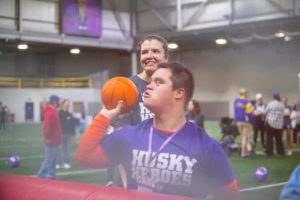
When UW Athletics reached out to the Haring Center’s Experimental Education Unit (EEU), they weren’t just offering volunteers, they were planting the seeds of a powerful partnership. What began with student-athletes showing up to play has grown into a deeply meaningful collaboration built on shared joy, belonging and the belief that all children deserve to thrive. Through this partnership, UW student-athletes are helping to reimagine what community, connection, and inclusion can look like, one playful moment at a time. This isn’t a new initiative. As Lana Sumner, assistant principal at the Haring Center, shared, “Since I’ve been here, it’s been happening all quarters.” Student-athletes from a range of sports — football, men’s and women’s soccer, softball, and gymnastics — regularly visit EEU students during recess and playtime, bringing joy and curiosity to a learning environment that centers children with and without disabilities. “They just have somebody to play with,” Sumner explained. “It’s wonderful. Teachers can step back and observe how the kids interact with others and how that play is extended.” These simple playground moments are building bridges. “It just helps to build a greater community,” Sumner said. “We’re in our little bubble here in our school, but it gets us to know other people on campus.” Coaches and athletes often express how “cute” and “fun” the visits are, and for the kids, the excitement is palpable. “The little kids get excited when there’s that recognition that, oh, the athletes are here.” At the heart of this partnership is an inclusive philosophy: all children, regardless of ability, deserve opportunities to learn, play and grow. “I hope that [the student-athletes] understand inclusive education settings better,” Sumner said, “and see that all people of all abilities can learn and play and grow and have fun together.” That spirit of inclusive joy took center stage during Husky Heroes, a new community event launched by Philip Carpio, assistant director for diversity, equity, and inclusion in UW Athletics. Husky Heroes invites children and adults with disabilities to experience Husky athletics in a way designed just for them.Caprio was inspired by his own family. “I have a nephew who is autistic, he requires a lot of assistance. He’s nonverbal,” Carpio shared. “I wanted to create an event that allowed kids and adults to be able to experience like Husky athletics in a way that worked for them.” The result was a vibrant, accessible celebration. “It’s a carnival-style field day,” Caprio described. “We had the noise canceling headphones, sensory bags, giveaways, all the stations were adaptable.” The event was hosted free of charge, thanks to support from Symetra, and included snacks, games, and more than 60 student-athlete volunteers. “We wanted to make sure that we literally just had something for everybody.” But the event’s impact rippled far beyond the day itself.“Our student-athletes absolutely loved the event,” Carpio said. “It allowed them to create a little bit of a community amongst themselves, but the sole focus was the kids.” For Carpio it’s about reminding everyone — athletes, children, families — that “sport is truly for everybody.” And that “they still want to be them, and they can be them. It just may look a little bit different.” Parents were moved. “We definitely had several parents that were literally like in tears,” Carpio recalled. “They’ve never been provided the event at no cost, we were doing it for the community, for no other reason than we wanted to do it.” This commitment has deep roots. For Carpio, who is Hispanic and queer, the work of inclusion is personal. “If I want people to stand up and fight for my identities, I have to be willing to do the same. We can’t let hate win,” he said. “We have to show love and empathy for each other.” And thanks to this work, that love is showing up, in small hands reaching for hula hoops, in giant athletes crouching at eye level, in spontaneous games of tag, and in the shared laughter echoing off a playground surrounded by glass. As Carpio ssput it: “We have 570 student-athletes that are trying to navigate this world as young adults, and we have to be the example.” Thanks to this partnership, they already are.
-
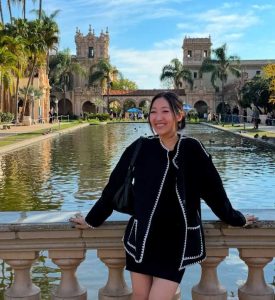
Chi Baik is a fourth-year doctoral candidate in Special Education at UW whose work focuses on early communication for children with cognitive disabilities and inclusive teaching practices. She coordinates community programs through the Haring Center in partnership with Open Doors for Multicultural Families. Read her Q&A below to learn more about her! Chi Baik Can you tell us a bit about yourself and what you’re focusing on in your doctoral studies? What inspired you to pursue this path? My name is Chi Baik and I am entering my 4th year here at UW! I am a doctoral candidate studying Special Education and I’m working on my dissertation this year. I am originally from Seoul, South Korea but immigrated to the US when I was 4. I grew up in Silver Spring, MD which is right outside of Washington D.C.! Prior to moving to Seattle for school, I was a preschool special education teacher supporting young children with extensive support needs. Through my own professional experiences, I became passionate about providing high-quality early support for children with significant cognitive disabilities. In particular, my research focuses on improving communication outcomes for young children who do not yet have access to systematic forms of communication. I am also interested in the impact of teachers’ perceptions of disability on teaching and inclusionary practices. How did you get involved with the Haring Center, and what has your role been in the collaboration with Open Doors for Multicultural Families (ODMF)? My advisor, Dr. Angel Fettig, is the director of research at the Haring Center! Through her, I’ve become more involved in research and partnership efforts with the community. Specifically, our lab has collaborated with ODMF (https://opendoorswa.org/), an organization that supports multicultural students and their families in navigating special education services. Our role in that support has mainly been to provide children and families with opportunities to attend early learning playgroups and parent education seminars! UW students plan and lead these sessions and it has been an awesome way to collaborate and connect with students and families in our community. My role is to coordinate these efforts with ODMF as well as assist in planning/leading sessions. What does a typical day look like for you coordinating the lab efforts with ODMF, and what kinds of work or support do you provide to families? My day-to-day work with ODMF can look very different! My main responsibility is to make sure everything is planned and ready so that things run smoothly. This generally just means a lot of email correspondence. In collaboration with UW, we run monthly playgroups and parent trainings. Our playgroups are planned and led by a group of our Master’s students who study either Special Education or Speech-Language Pathology. These playgroups have a different, culturally-relevant theme for families each month. For example, some of our themes this past year were: Indigenous Heritage Month, Eid and Ramadan, Cinco de Mayo, and Lunar New Year. The goal of these playgroups is to encourage and support parent-child interactions for children with disabilities. Students create lessons plans (which I’ll review and coordinate materials for) and implement them once a month in 3-hour sessions. For our parent trainings, our doctoral students in Dr. Fettig’s lab, who are all studying Special Education, plan and lead sessions. Session topics are decided in collaboration with ODMF and reflect families’ interests. Some of our topics last year were: Disability Resources/Advocacy, Child Development/Social Skills, Therapies and Related Services, and Challenging Behaviors. Students create about an hour-long presentation with relevant resources and then have time for a Q&A from families. These sessions are delivered online once a month and, in the evenings, to be flexible and meet families’ needs. Through your work with ODMF and the families they serve, what have been some of the most meaningful experiences or lessons you’ve taken away? As a child who grew up in a low-income, immigrant family whose parents were not proficient in English and did not know how to navigate school systems, I understand the impact of the work that ODMF does on a personal level. I am so happy to see that there are organizations like ODMF who are dedicated to supporting families like mine and even happier that I get to support them in their work. I would say that my most meaningful experiences have been in seeing the relationships between children, families, UW students, and ODMF staff grow throughout our partnerships together. We often see the same children and families attend our playgroups and parent trainings and it’s wonderful to get to know each other not just on a professional level, but on a more personal level as well. Outside of your research and work, what do you enjoy doing in your free time? In my free time, you can catch me at a lot of different concerts because I love live music! I also love enjoying the beautiful weather in Seattle and am usually lounging on the beaches in the summer. When I’m inside, I spend a lot of time doing puzzles, solving crosswords/sudoku, or building legos.
-